


Global trade has rarely felt more uncertain, or more full of opportunity. That tension was at the heart of the panel discussion at the 2026 CITP Gala, where a group of experienced international trade advisors explored how companies are adapting to shifting geopolitical dynamics, evolving market conditions, and the rapid rise of AI.
The session, “Leadership in Action: Advisors at Work,” brought together perspectives from government, consulting, finance, and trade education to answer a central question:
How can businesses, and the trade professionals who support them, move forward with confidence in a volatile world?
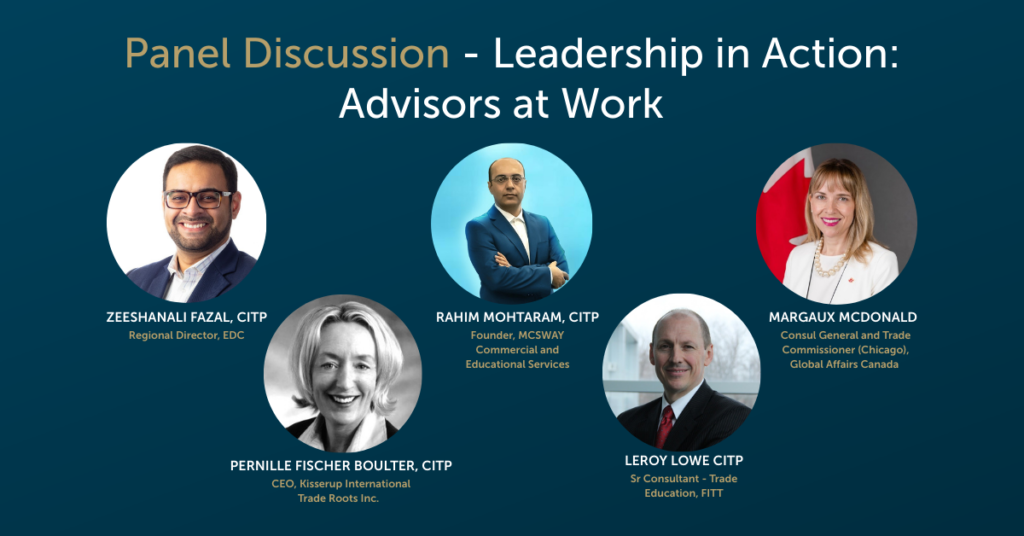
Moderated by Lora Rigutto, CITP, Partnerships & Community Lead at FITT, the panel featured:
- Margaux McDonald, Canadian Consul and Senior Trade Commissioner in Chicago (Global Affairs Canada)
- Zeeshanali Fazal, CITP, Regional Director at Export Development Canada (EDC)
- Dr. Rahim Mohtaram, CITP, Founder of MCSWAY Commercial and Educational Services
- Pernille Fischer Boulter, CITP, CEO of Kisserup International Trade Roots Inc.
- Dr. Leroy Lowe, CITP, Senior Consultant – Trade Education at FITT
Together, they unpacked emerging trends in exporter mindsets, market diversification strategies, and the evolving role of trade professionals in an AI-driven world.
A new export mindset: From growth to resilience
The past year has been marked by political volatility, tariff concerns, and supply chain disruptions. According to the panelists, the biggest change has been in how exporters think about international expansion.
Zeeshanali Fazal, CITP, has seen this shift firsthand through his work with Canadian exporters at EDC.
“Instead of going growth first, they’re going to resilience first,” he explained. “Companies have had the opportunity to experience what risk can look like, even when we thought there was no risk.”
Rather than focusing solely on revenue growth targets, companies are now prioritizing strategies that help them manage uncertainty and survive disruption.
Fazal noted that exporters are increasingly asking practical questions:
- What happens if tariffs suddenly return?
- How exposed are we to geopolitical risk?
- Are our payments and financing structures secure?
This shift has led many businesses to make greater use of trade finance tools such as guarantees, insurance, and structured financing to mitigate risk.
At the same time, companies are thinking more strategically about diversification.
“We’ve talked about diversification for years,” Fazal said. “But now it’s more practical. People are moving to action.”
Canada–U.S. trade: Stable despite the headlines
Much of the uncertainty surrounding Canadian trade in the past year has centered on the United States. Yet Margaux McDonald, who leads Canada’s trade team in Chicago, offered a perspective from the ground that may surprise some observers.
According to McDonald, the reality for many companies has been more stable than expected.
“A year ago, everyone was bracing for what felt like a giant storm,” she said. “But for the vast majority of Canadian companies, that storm never fully landed.”
In fact, some Canadian exporters have quietly benefited from shifting trade dynamics.
“When I walk trade show floors and ask companies about the impact of tariffs, sometimes their voice lowers and they say, ‘Don’t tell anyone, but this has been really good for us.’”
This paradox highlights how complex global trade dynamics can be. In some cases, tariffs affecting U.S. competitors have created unexpected advantages for Canadian firms.
Still, McDonald emphasized that exporter attitudes are evolving in important ways. She highlighted three major shifts she has observed among Canadian companies.
1. A stronger demand for clarity
Companies want practical guidance on trade agreements, regulations, and incentives.
“There’s been an awakening to the complexity of trade, and how to navigate it effectively. And that’s where this cohort, this community of CITPs, can be so helpful.”
2. More targeted expansion strategies
Instead of pursuing broad market entry, exporters are focusing on regions where they can win.
“There used to be a spaghetti-against-the-wall approach. Now companies are asking: where can we actually succeed?”
3. Greater focus on trusted partnerships
Canadian firms are increasingly prioritizing long-term, values-aligned business relationships.
Diversification: Supplement, not replace
While diversification beyond the U.S. is gaining momentum, panelists stressed that the strategy should be approached carefully.
Pernille Fischer Boulter, CITP, whose consulting firm works globally with exporters and development agencies, cautioned against treating diversification as an all-or-nothing decision.
“We’re not telling companies to pull out of the U.S. We’re telling them to supplement.”
Canada has access to a wide network of international trade agreements covering dozens of countries. Expanding into new markets, however, takes time, resources, and careful planning.
Fischer Boulter sees companies increasingly looking for low-hanging fruit, markets where they already have some traction or early success.
“If they have a little bit of success in a market like Poland, suddenly they say, ‘Wow, I can do this.’”
Diversification often starts with small wins rather than dramatic strategic shifts.
Strategic supply chains and new trade partners
Dr. Rahim Mohtaram, CITP, highlighted another emerging trend, strategic supply chain realignment.
As companies reconsider their reliance on specific markets, many are exploring partnerships with what he called “middle powers” in global trade.
“Some companies are thinking about working more with China, the European Union, Australia, Japan, Southeast Asia, and even smaller countries,” he said.
However, Mohtaram stressed that diversification does not mean abandoning the United States.
“The U.S. has been the main partner of Canada for export and import, and it will remain the main partner,” he said. “But companies want more options and more alternatives.”
The SMEs facing the biggest challenges
While larger exporters may have the resources to explore new markets, smaller companies often face tougher choices.
Dr. Leroy Lowe, CITP, who works closely with SMEs through training and consulting, has seen firsthand how regulatory uncertainty can disrupt small exporters.
For many small businesses, the unpredictability of tariffs, brokerage fees, and shipping costs has made pricing difficult.
“Some companies are finding their shipments are ending up in customers’ hands at very unpredictable pricing,” he explained. “And that can break partnerships.”
Without the resources to expand globally, many SMEs are taking a different approach.
“One workable short-term solution is simply looking at other places in Canada they haven’t been,” Lowe said.
Expanding into new provinces can help companies grow while building the experience needed to pursue international markets later.
Overcoming exporter hesitation
One challenge that trade advisors consistently encounter is exporter hesitation. Faced with uncertainty, many companies adopt a “wait and see” strategy. The panel agreed that waiting too long can mean missed opportunities.
McDonald described how the Trade Commissioner Service helps companies move past uncertainty.
“We never want to convince anyone to do anything,” she explained. “But we can provide context, grounded analysis, and most importantly, connections.”
Helping companies distinguish between political noise and real market changes is an important part of that process.
“There’s a lot of hyperbole and dramatic headlines right now,” she said. “Part of our job is helping companies understand what’s actually changing, and what might just be theater.”
Fazal agreed that hesitation often stems from lack of awareness.
“When I ask companies what they know about new markets, they often say, ‘We don’t know anything, and we don’t even know where to find the information.’”
For trade professionals, bridging that knowledge gap is a critical role.
Choosing the right markets
When companies do decide to diversify, choosing the right market becomes the next challenge. Fazal described a framework he calls risk triangulation.
This approach evaluates three key elements together:
- Country risk
- Buyer risk
- Transaction structure and financing
“It’s not just about selling. It’s about where you sell, who your buyer is, and whether you’ll actually be paid.”
Lowe added that technology is increasingly helping consultants guide these decisions. He frequently uses AI tools to analyze market characteristics and identify potential opportunities.
“You can ask: what would be the ideal attributes of a market for this company?” he explained. “Then you score potential markets and narrow the list before doing deeper research.”
AI and the future of trade advisory
The conversation eventually turned to a topic dominating many industries, artificial intelligence. Rather than replacing trade professionals, panelists agreed that AI is enhancing their capabilities.
Lowe described AI as a tool that allows advisors to move faster.
“You can gather a lot of information quickly,” he said. “But you still need expertise to evaluate the quality of that information.”
Fazal emphasized the distinction between data and judgment.
“AI handles information,” he said. “But we as CITPs interpret the risk, the context, and the strategy.”
Pernille Fischer Boulter highlighted another advantage trade professionals bring: networks.
“Our networks tie people together in ways AI can’t replicate.”
Mohtaram offered a broader perspective.
“Automation and systems improve businesses, but they also increase the need for people with higher levels of skills.”
The human advantage in global trade
As the panel concluded, one message stood out clearly.
The role of trade professionals is evolving, but it is not disappearing. In a world of geopolitical shifts, complex regulations, and rapidly expanding information, the ability to interpret, connect, and guide strategy is becoming more valuable than ever.
For CITPs and other trade advisors, the future is not about competing with technology. It is about combining data, experience, and human insight to help companies navigate an increasingly complex global economy.





disqus comments