


Trade is ancient. The practice began even before some languages and civilizations were born, with the earliest records and evidence dating back approximately 8,000 years ago, or roughly 6000 BC.
And if you think about it, the human need to exchange or barter for goods and services has always been essential to our survival. It has allowed us to grow, expand, diversify, and join forces with other like-minded humans and nations—and in this basic notion, we can find the kernel of what keeps trade unified today.
We still need to cooperate and exchange goods and services with other countries and people, because it not only helps us survive, but ultimately to flourish.
Though the job market is increasingly difficult to navigate, knowing the basic reasons for why we always have and always will exchange goods and services can provide direction and relief.
Yes, trade today is not the methodical industry it once was. It moves at the speed of digital platforms, automated customs systems, AI-driven forecasting tools, and geopolitical realignments that can disrupt an entire region overnight.
Yes, the skills that people need to have to keep up with these transformations are manifold. Yes, there are multiple economic, political, and environmental disruptions in the mix. But, people and countries still need to trade, and this will never stop.
So, if you’re looking for a job in the global trade market right now, there are some great ways to get started in the field, first and foremost by getting the right training.
And from there developing on-the-job experience through internships, mentorships, or junior roles. Let’s not forget the increasing power of networking in today’s tempestuous hiring waters too.
Starting from scratch in the field of international trade? Read our tips below and begin carving your path to a profession that’s always evolving yet as enduring as civilization itself.
Know your learning options
There are many learning options for business in general. These range from highly specialized courses on individual topics like Incoterms or customs compliance, to broader selections, like general business administration, or project management through degrees like an MBA or certifications like the PMP.
For newcomers who want a broad understanding of global trade in addition to a practical roadmap for how to start, grow, and manage a business across borders, the FITTskills program and the CITP®|FIBP® designation provide one of the more structured and widely recognized pathways available, a sentiment that Daiana Leandro, Customer Success Specialist, Ocean Sonics Ltd. agrees with.
Just as lawyers and doctors have recognized professional standards, Daiana ventures that the CITP® designation gives international trade professionals a recognized benchmark of expertise, ethics, and commitment.
“I think that having a professional designation is important to back you up. To show that you’re committed to what you’re doing,” says Daiana.
For professionals like Julia (Xia) Zhao, CITP – President, Raintree International Trade Co. learning about international trade through validated courses also adds confidence to your arsenal.
“Don’t just work hard. Educate yourself and work harder,” she recommends, adding that completing the FITTskills program gave her a better understanding of the rationale behind decisions and their execution, and provided a significant boost to her ability to collaborate with her colleagues in different roles within the industry.
The FITTskills Program: What it covers
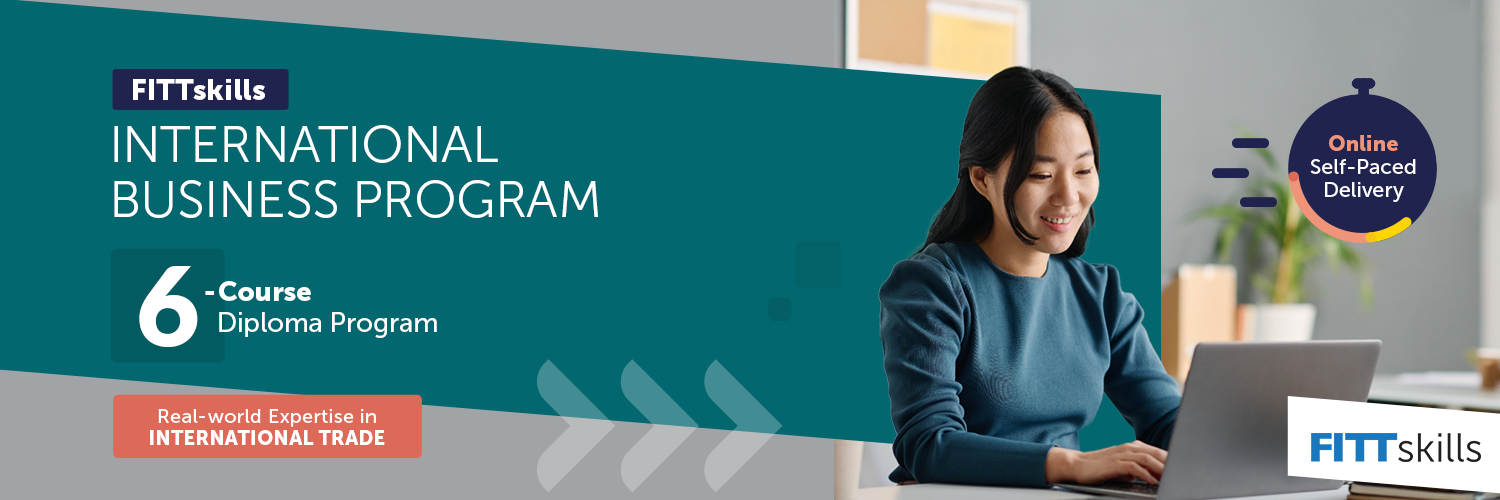
Rather than offering theory alone, the FITTskills program breaks global business down into a practical and straightforward set of steps, strategies, and skills that all international business professionals must know and execute in real life.
While some business programs emphasize high-level theory, FITTskills focuses on the practical side of doing business internationally. For product and service exporters – including technology companies – this includes topics like exporting digital products and services, navigating international compliance and procurement requirements, managing global partnerships, understanding market-entry considerations, and working across different regulatory and cultural environments.
For those who advise businesses in international trade it helps them understand the challenges and needs of their clients to be able to meaningfully support them. It’s designed to help professionals apply international business concepts directly to real-world operations, sales, and global growth.
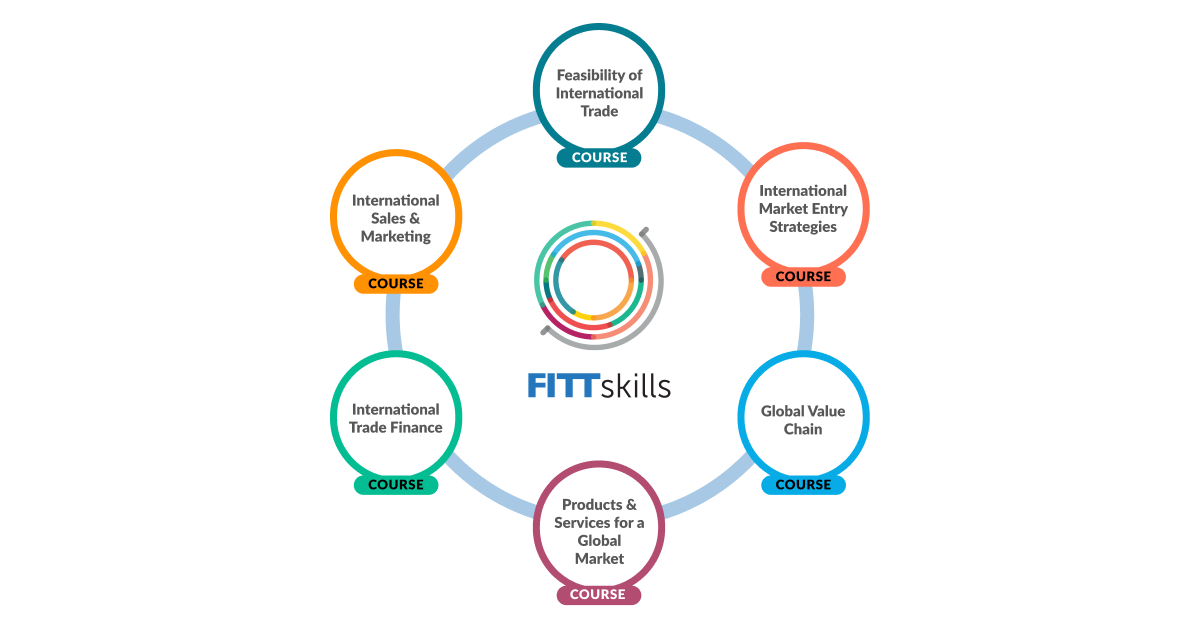
The program’s six courses mirror the lifecycle of an international business venture, from assessing feasibility all the way to executing sales across borders.
Learning online: flexibility for a world that never stops moving
Many who enter the field today do so while balancing full-time jobs, family responsibilities, or immigration transitions. For these learners, the ability to train online—on their own time—can be the difference between entering the field and never getting started.
Sajal Takhi, CITP, provides an illustrative example of this.
Despite balancing a demanding career in logistics and pursuing a Master’s in Finance, Sajal was able to complete two FITTskills courses. It was such an enriching learning experience that he decided to complete the entire FITTskills program. He went on to apply for his Certified International Trade Professional (CITP®|FIBP®) designation, understanding its ability to open international doors and add credibility to his CV.
“These courses significantly deepened my knowledge, allowing me to apply advanced analytical skills directly to my work in logistics. This enhanced my ability to make data-driven decisions, mitigate risks, and optimize costs, ultimately contributing to the growth of the company and adding value to the broader community.”
In-class instruction: where conversation becomes understanding
For others, learning becomes more powerful when it happens in a room full of different perspectives and background and includes the face-to-face interactions, discussions, and hands-on projects that come with in-class learning.
Teniola Animat Oke, winner of the International Business Plan Award at the 2024 FITT Educational Awards notes the value for her in going through the process to complete her project.
“Completing this project was incredibly rewarding,” Teniola said. “It pushed me to integrate everything I learned – market analysis, financial planning, risk management, and cultural adaptation – into an actionable plan. It reinforced my passion for international business and my confidence in tackling complex, multifaceted challenges.”
Extended learning: where skills turn into opportunity
CITPs often emphasize mentorship as a turning point in their careers.
Audrey Marie-Nely – Associate Vice-President, Banking, RBCx, saw the benefit of mentorship firsthand, through a mentorship program facilitated by FITT:
“Before moving to Canada, I didn’t realize the power of mentorship. Through a FITT mentorship program, I was matched with an experienced trade professional who provided invaluable guidance. Even though the formal program has ended, we still keep in touch.”
She adds, “Mentorship is a way to give back and help others navigate the complexities of global trade. It’s something I plan to continue throughout my career.”
Networking: A powerful tool for growth and connection
Networking as a practice has undergone a wide-ranging transformation in the past few years. COVID-19 saw the rise on online networking events, but post-pandemic, in-person events gained back momentum as people realized they missed the subtle yet irreplicable business nuances of connecting with other people in person, face to face.
Whether in-person or online, networking still remains fundamental to career growth, especially in the international trade field. These connections are critical to finding strategic partners and contacts across borders, and for job hunters, they’re also essential for meeting potential employers in the field.
Julien Rosan, CITP and Trade Commissioner, Global Affairs Canada, agrees wholeheartedly. At the beginning of his career, Julien relied on his knowledge and interpersonal skills to find a job. But after many years in the field, he now sees how crucial it is to network, seek referrals, and build professional relationships. Nowadays, when he receives LinkedIn requests from students seeking advice or internship connections, he makes it a point to remain as approachable and helpful as ever.
“I love this proactive approach and always keep my door open as I can see myself in them 10 years ago.”
Internships: more than a foot in the door
Even a short internship can ignite a new career. Steve Jobs, Oprah Winfrey, Ursula Burns and Steve Spielberg all performed internships, with many of these experiences launching the legends into their lifelong careers.
Ian Murdoch, CITP, experienced the benefits of internships firsthand, when he travelled to Kenya for a six-month internship through a program at the Norman Paterson School of International Affairs at Carleton University.
Through his experience, he assisted a coffee farm with sustainable business development and international trade. This opportunity sparked his interest in the field as it offered him a chance to work with people from around the world and contribute to an important cause like sustainable growth and development. The experience also accelerated his passion for international trade, a profession that he still pursues as a Trade Commissioner at Global Affairs Canada.
Learning on the job: letting the job teach you
Those who stay in the field long enough often say the same thing: the work itself becomes the teacher.
“In the beginning, everything seems overwhelming” says Ramon Pinto, CITP, President & CEO, SOLUPAPER LLC whose $60K startup eventually evolved into a multimillion-dollar cross-border company. But with work and patience, success can come:
“Instead of taking quick, expensive routes, we focused on sustainable expansion, reinvesting our profits and seeking financing only when absolutely necessary. It wasn’t easy, and many times it felt like we wouldn’t make it, but every financial hurdle taught us to be more resilient and manage our resources efficiently. The key was always keeping the long-term vision in mind, knowing that each sacrifice today would bring us closer to success tomorrow.”
He describes the trade career as a constant exercise in judgment; reading markets, picking partners, understanding risks, sensing change before it arrives.
“We made decisions based on data analysis and trends, and we weren’t afraid to invest in areas that seemed uncertain. Today, that vision has allowed us to maintain a solid sales trajectory and continue moving forward despite industry shifts.”
He adds that,
“If you never stop learning you increase your opportunity to grow, adapt, and improve.”
Carving a path is a unique experience for each individual, but effort always drives success
Across a myriad of professional trade careers, it’s clear that no one path is identical. Some enter the field through in-class instruction, while others take on mentorships and internships.
And yet, despite these differing routes, advice rooted in personal effort remains parallel:
- Start with foundational training to validate expertise and build confidence.
- Seek out real experiences, even entry-level ones, that expose you to how goods, money, and decisions operate on a day-to-day level.
- Build relationships and contacts, as these connections open business and career opportunities
- Find a mentor, and someday, become one to learn from and contribute to a deep community of experts
- Stay curious, and keep learning to stay ahead of industry transformations
Much like the evolution of trade itself, progress, even in the face of setbacks, is attainable. You just need to remain patient and keep moving forward.





disqus comments