


Founders set up businesses for many reasons, but the most common motivations include spotting an underserved market, leveraging their own abilities or networks, or simply fulfilling a passion. Some take a “product-first” approach, while others, often more agile, go “market-first.” The vast majority start off by directing their attention to nearby customers, those within their personal circle and local area.
This approach is logical. The challenges are immense, and new owners rely on existing connections and their comprehensive knowledge of the market to minimize unpredictable variables and business uncertainty. For this reason, entrepreneurs usually start with local customers and operate within the local market. They study adoption rates, refine their offering, and begin to see traction, growing their turnover and reaching a stable market position. Some may fail, but that’s part of the journey.
So, what’s next? As the business grows and enables them to save resources for further investment, founders can begin to look beyond domestic borders: what about exporting? Can we serve this unexpected request coming from this far away market?
This is the moment to consider internationalizing the business.
And, after earning well-deserved confidence from leading a market or niche, the question becomes: how do you win this next challenge?
Replicating domestic strategy doesn’t work internationally
While success in the local market can be a strong foundation for launching a company abroad, it can also become a trap. Simply replicating local practices may prove unsuccessful with foreign customers. Adaptation—not only of the product but of the entire company’s operations—will require time, investment, and (a lot of) persistence.
Often entrepreneurs will make that leap to a new market and think, “We did it! International customers are happy, and orders keep coming in! We made it!” only to realize the celebration came too early.
Exporters also need to be prepared for what comes next: the after-sale phase.
Customer assistance peaks, orders are returned, warranty claims absorb unpredictable amounts of cash, and the whole business starts to become less profitable. So how can businesses set themselves up for export success from start to finish?
While roadblocks are inevitable (external factors are numerous and not always predictable through research or experience) entrepreneurs launching new businesses or products can benefit from using a framework to simplify the process.
Start by placing design at the center of all conceptual work. Encompass all activities needed to build, communicate, and deliver a successful and scalable product both nationally and internationally, based on the principles of “Simplicity, Scalability, Safety”.
Designing a product ready for international market growth
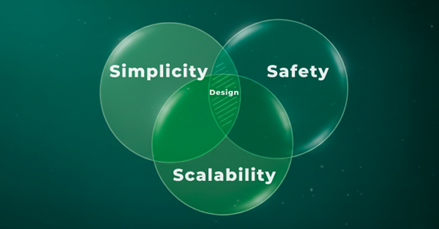
Let’s apply this model with concrete ideas. The activities outlined below are not meant to provide a detailed and comprehensive sequence of “tasks” to follow but serve as examples of ways to optimize when setting up or developing a product in multiple markets.
The ultimate goal is to demonstrate how to build a business as scalable as possible, where scalability is achieved by selling both internationally and domestically.
Simplicity
Set up clear, honest communication
Companies that adopt a clear communication strategy are well-suited to expand into international markets with minimal adaptation effort or growing pains. Create a content strategy that features easy to understand, intuitive messaging and information, supported by simple visual tools like infographics, images, and videos. Distribute them on the channels used by your target markets such as international social media platforms, and be prepared to localize and translate all content for each market. You can start with English content first to be more broadly accessible.
Approach: Use transparent communication, highlighting the pros of your offer without overpromising, and being clear of its limits (of performance, application, etc.). A frank style allows the international customer to understand your product’s real advantages, increasing the chances of positive acceptance upon real expectations[1].
Format: deliver your content in more than one media format (website, brochures, digital ads, videos, etc.), professionally drafted for a wide (multi-country) audience.
Channels: design and launch an attractive and clear company website, and build a consistent presence in international social media.[2]
An additional practical recommendation is to register local domain extensions for targeted markets to protect brand identity and prevent misuse by others in new regions.
While the “.com” domain is still one of the safest options, companies that begin their business domestically often have a local domain. Before entering new markets, companies should register the local domain extension to prevent competitors or former partners from misusing the brand.
Engineer for easy adoption
When designing a new product, engineer it to be easy to set up, use, and maintain. Carefully study the customer’s experience from the moment they receive the product, and provide clear instructions—not only in text, but also through multimedia formats such as QR codes linking to informative landing pages or video tutorials.
Design the product for intuitive operation and simplified maintenance to minimize product returns, increase customer satisfaction, and reduce post-sale support and warranty costs. These benefits are significant for local customers but become essential for buyers located abroad (and sometimes very far away).
In addition, implement an effective sampling strategy to support product adoption by new buyers: offer smaller-sized products, material samples, and customization options all in one convenient kit that can be shipped for trial before a first order.
Since shipping products (often free of charge) can be expensive, compact sample kits are a cost-effective solution for international markets.
Plan for easy customization
Whenever possible, design products to be easily customizable. One way to do this is to add custom features to a single base product, so that parts can be applied as “customized accessories.” While this approach may involve sacrificing certain features, it delivers significant advantages in reduced inventory requirements, lower personalization costs, and faster achievement of economies of scale.
For example, if a manufacturer plans to launch a new chair collection in different colors, this typically means multiplying inventory or incurring extra “last mile” customization costs for each order. Instead, consider using the same wooden base with a standard upholstery, allowing customers (or company staff) to apply colored fabric themselves. The fabric can be shipped with the chair and included in the setup instructions, eliminating additional handling and manufacturing costs.
The same principles apply to modular product design.
By creating products from different modules that can be easily assembled by the customer, manufacturers can ship items in a compact form and achieve significant benefits.
These advantages include economies of scale, easier personalization, and more efficient transportation.
Modular design allows manufacturers to standardize components, streamline production, reduce inventory costs, and offer varied product configurations simply by switching modules. This approach also ensures flexibility to meet customer preferences, simplifies assembly, and lowers shipping expenses, making it ideal for both operational efficiency and international logistics.
Scalability
Optimize your product for efficient logistics and operations
Many of the ideas discussed for making things easy translate directly into operational efficiencies and cost savings. For example, well-engineered product modularity leads to shared components, consolidated semi-finished products, and reduced inventory. This makes it much easier for companies to expand into new markets through more efficient working capital management and optimized packaging and transportation.
The same principle applies to product accessories and packaging. Using standardized packaging for multiple items, planned with dimensions to fit various products and customized only through labeling, reduces complexity, simplifies warehousing, and lowers investment requirements. This streamlined approach supports market expansion and sustainable logistics by minimizing handling, inventory, and overhead.
Safety
Safety as a feature
Safe materials, robust performance, and user safety generally pave a smoother path toward international readiness. Designing a product’s shape, features, and use of high-quality, non-harmful materials, focusing on detailed components and ease of assembly and modularity, will all help reduce compliance requirements for multiple markets.
Modularity brings additional advantages here: for example, sensitive components like an electrical engine can be outsourced or assembled locally, which may significantly simplify or reduce the scope of electrical compliance certifications.
Similarly, if a local partner adds large-volume elements such as a chassis or fills liquids, shipment costs and import tariffs can be lowered substantially.
This strategic design and outsourcing approach facilitate regulatory compliance, reduces logistics costs, and supports efficient entry into international markets.
How it all comes together to build a product ready for export
Management decisions in any company trigger cascading effects across the business’ many sectors and activities. The points listed here have immediate, short-term, and mid-term impacts on a company’s capacity to compete internationally, helping to avoid costly and resource-intensive late corrections.
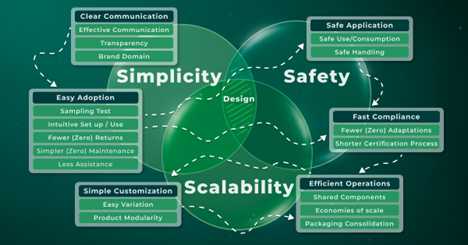
The above ideas, while sometimes more applicable to certain industries or products, present a general framework of proactive strategies to design competitive and adaptable products for international markets.
Although these design approaches enhance a company’s competitiveness both domestically and internationally, the heightened challenges, costs, and complex competitive dynamics inherent in global markets make these strategies even more crucial. In other words, they simplify and accelerate the company’s path to global success by minimizing painful, resource-intensive corrections in a later stage.
[1] The management costs of an unsatisfied foreign customer can be drastically higher than the same profits which can be generated by the original sale.
[2] Before opening a social media account, the company must be sure to dedicate sufficient resources for regular posting, prompt replies, audience moderation.





disqus comments