


In today’s competitive job market, both students and professionals are searching for ways to advance their career prospects. They want to stand out from other contenders but also want to stay relevant in a fast-moving career gauntlet where jobs are scarcer and hiring expectations higher.
In North America, hiring is down significantly from the pandemic peak. As of publishing, the U.S. hiring rate sits at about 3.5% (about 5.6 million hires) and in Canada, the national unemployment rate is 6.9%. That’s not quite recession-level lows, but a far more cautious job market than the 2021-2022 hiring peak.
Factor in the rise of AI, which is replacing some of these previously human-operated roles, and you have an ecosystem that requires candidates to not only possess great experience and skill but also something extra to make them stand above the rest.
Today’s jobseekers often pursue extra credentials—whether degrees, certifications, or workplace training—to gain an edge. But deciding which route to take isn’t easy. The landscape is crowded, and each option offers a distinct kind of value.
In the international trade field specifically, many people gravitate toward either an MBA or the CITP, begging two important questions:
What’s the difference between an MBA (Master of Business Administration) and the CITP®|FIBP® (Certified International Trade Professional) designation?
And which increases your chances of getting hired?
What’s the difference between an MBA (Master of Business Administration) and the CITP®|FIBP® (Certified International Trade Professional) designation?
And which increases your chances of getting hired?
The short answer is this: both credentials are valuable, but for very different reasons. Both can increase your chances of getting hired, but depending on the role you seek, you may experience far more competition with one versus the other.
The right choice depends on where you want your career to go, how specialized you want your skills to be, and how deeply you want to work within the world of international trade.
Sometimes, if you ask, the answer comes swiftly: Audrey’s story
Audrey Ross, CITP, for example, decided to go for the CITP based on the advice of her instructor. She was already in university when she landed a job role that dealt with the inner workings of international trade.
“I got this job and I was enjoying it. I got to work on everything from product development and global sourcing to procurement and buying and doing style specs and costing and all these fun things. Then, I decided about 5 or 6 years into my work that I wanted something external to have more market knowledge, because I was getting a lot of great knowledge internally, but I wanted that external professional information.”
She signed up for an Advanced International Trade Certificate at George Brown College in Toronto and started doing classes on evenings and weekends. She didn’t realize it at the time, but the courses she was taking were FITT accredited. She found them to be interesting and hands-on, giving her more insight into the practical applications of international trade on an international level. About 9-10 courses in, she decided to ask her instructor for advice:
“I said to him ‘What do you recommend my next step be career-wise? Should I really buckle down and do a degree or an MBA, what do you think? He turned to me and said, ‘You need to get your FITT Diploma and become a CITP.’ I was really anxious about not having a degree, and he was like ‘No. You don’t need that. You want this professional designation because it’s well recognized, you’re going to meet great people, it’s a great community and it’s international. It’s not just focused on what’s happening locally. It’s completely international.’”
This turned out to be the right decision for Audrey. She has now been working in the field of international trade at Orchard Beauty for over 20 years and has been a CITP for 7.
“The FITT program is so comprehensive. It really covers such a good breadth of what you’re going to experience in business. So, in a labour market where you’re challenged to hire, I’m struggling to hire qualified candidates myself, when you see what my fellow CITPs are doing, you’re looking at very successful growing enterprises, and it can really level up your company with expertise and knowledge.”
She adds “The way a lot of entrepreneurs and businesses get started, it’s about the customer and it’s about the sale. And that doesn’t really mean much until they actually get into how they’re going to fulfil the sale when it’s in another country and what’s involved in that. And that’s when people realize, ‘oh there are all these international regulations and standards.’ That’s international trade.” For Audrey, the CITP encompasses these intricacies of trade, where an MBA wouldn’t have.
Comparing the MBA and the CITP
Looking for more insight into the difference between an MBA and CITP designation? Below, we break down the key differences, strengths, and limitations of each path so you can make a confident, strategic decision.
What an MBA gives you
Broad business leadership training
An MBA is designed to build well-rounded managers and leaders. Most programs cover foundational business disciplines, including
- Strategy
- Finance and accounting
- Marketing
- Leadership
- Operations
- Organizational behaviour
It prepares graduates to think holistically about organizations, not just one function or discipline.
Time and cost
- 1–2 years full-time (or longer for part-time and executive programs)
- High financial investment, typically $30,000–$100,000+, depending on the school
Career outcomes
MBA programs are ideal for professionals who want to move into:
- Corporate leadership or management
- Consulting
- Banking and finance
- Startups or entrepreneurship
- General business roles across many industries
Strengths
- Globally recognized and respected
- Access to strong alumni and industry networks
- Versatile across industries
- Often accelerates promotion into management
Limitations
- Not specialized in international trade
- Does not train students on operational trade skills
- MBA graduates often require additional training to work in:
- Customs compliance
- Import/export operations
- Global logistics
- Trade finance
- Supply chain management
If your goal is broad business leadership, the MBA fits the bill. But if you want to build a trade-specific skill set, including understanding the day-to-day rules and regulations around importing and exporting for both products and services exports, you’ll need something more targeted.
What the CITP gives you:
Specialized, practical, trade-specific expertise
The CITP designation is the global standard of competency for professionals working directly in international business. It validates applied knowledge in areas such as:
- Trade compliance and customs
- Documentation and regulatory requirements
- Market entry strategy
- Risk management
- Trade finance
- Global logistics
- Supply chain operations
- Incoterms® rules
- International marketing and sales
- Procurement
Unlike an MBA, which is broad and theoretical, the CITP focuses on hands-on, job-ready skills.
Time and cost
- The educational component can be completed in months, not years
- Much lower cost than MBA programs
- Built for working professionals who need practical, immediate knowledge
Career outcomes
The CITP designation is ideal for roles including:
- Trade Compliance Specialist
- Customs and Regulatory Analyst
- Export/Import Manager
- International Logistics and Operations Coordinator
- Global Supply Chain and Procurement Analyst
- International Business Development Manager
- Market Expansion and Diversification Specialist
- Trade and Investment Advisor
- International Trade Consultant or Export Advisor
These are roles where employers often require—or strongly prefer—verified professional competence. Today’s international trade professionals do far more than manage shipments – they help organizations grow globally through strategy, sourcing, partnerships, services, and market expansion.
Strengths
- Industry-recognized and employer-valued
- Competency-based and aligned with real global trade standards
- Demonstrates practical skill, not just academic knowledge
- Frequently listed as an asset in trade-related job postings
- Prepares professionals to contribute from day one by identifying global business gaps, applying trade frameworks and best practices, and supporting actionable international growth strategies.
Limitations
- Less relevant if you plan to manage domestic transactions with no global focus
- More focused on the day-to-day business operations, strategies, and processes, less so on broad management
Which one should you choose?
The easiest way to decide is to look at your career goals.
Choose an MBA if you want to:
- Move into senior corporate leadership where this degree is listed as an asset
- Pivot into domestic consulting, finance, or general management
- Strengthen your overall business knowledge
- Work outside the global trade ecosystem
Choose the CITP if you want to:
- Build a career specifically in international trade
- Work effectively across cultures and international business environments
- Support market diversification and global growth initiatives
- Add specialized trade expertise to complement existing business credentials
- Enhance consulting or advisory credibility with trade-focused clients
- Gain practical, job-ready skills quickly
- Advance in the trade profession without taking years off work
- Increase your credibility with employers and clients
- Join a professional network of international trade practitioners and experts
In short:
MBA = Broad management and leadership training across all areas of business, from finance and marketing to strategy and operations domestically
CITP = Expertise in international trade, covering areas such as global business strategy, market entry, logistics, finance, and trade compliance
Should you ever get both?
Absolutely, many professionals do.

Take Ana Rosetephane Quilas-Nassif, for example. As the Manager for Corporate and Executive Governance, Board Affairs, Soluis Group, both her MBA and CITP have had profound impacts on her career.
She felt that her MBA gave her the strategic mindset needed to navigate complex global business environments and take on leadership roles at Soluis and Edify. Meanwhile, her Certified International Trade Professional (CITP) formally validated her global trade expertise.
“I pursued the CITP designation because I wanted to formally recognize my expertise in international trade and strengthen my credibility in the field.” She adds, “The designation is globally respected and signals a high level of competency, which is crucial when working with clients, investors, and international business leaders.”
For Anna, both additions to her resume and skillset are valued and useful in her career.
For those looking into both, the combination can be especially powerful if you want to:
- Lead an international business unit
- Run global supply chains
- Become a director of trade compliance or logistics
- Start an import/export business or consultancy
- Lead global operations for a multinational company
Making an informed decision—that’s the most important part
If you’re early in your career—or watching your budget—the CITP can be a quicker, more direct route into trade roles, with strong ROI. However, an MBA has long-term benefits with leadership positions that require that specific degree.
In the world of international trade and importing and exporting specifically, both have strong value, but the CITP is designed to develop practical, globally focused business expertise.
While it includes specific operational competencies such as understanding compliance requirements and Incoterms®, the designation also builds skills in areas like international procurement and sourcing, service exports, market diversification, cross-cultural communication, supply chain risk management, and global market expansion.
An MBA provides broad business education, whereas the CITP offers specialized knowledge and professional credibility tailored to the realities of international trade and global business growth.
Regardless of which direction you go, you’ve already made a great decision by looking at all your options in detail—and that’s a great stride toward career growth.
Quick summary: MBA vs. CITP
| Feature | MBA | CITP |
| Focus | Broad business | Global trade specialization |
| Cost | High | Moderate |
| Career Track | Management, consulting, leadership | Trade compliance, trade advisory, logistics |
| ROI Speed | Slower | Faster, job-specific |
| Best For | General business leaders | Trade practitioners |
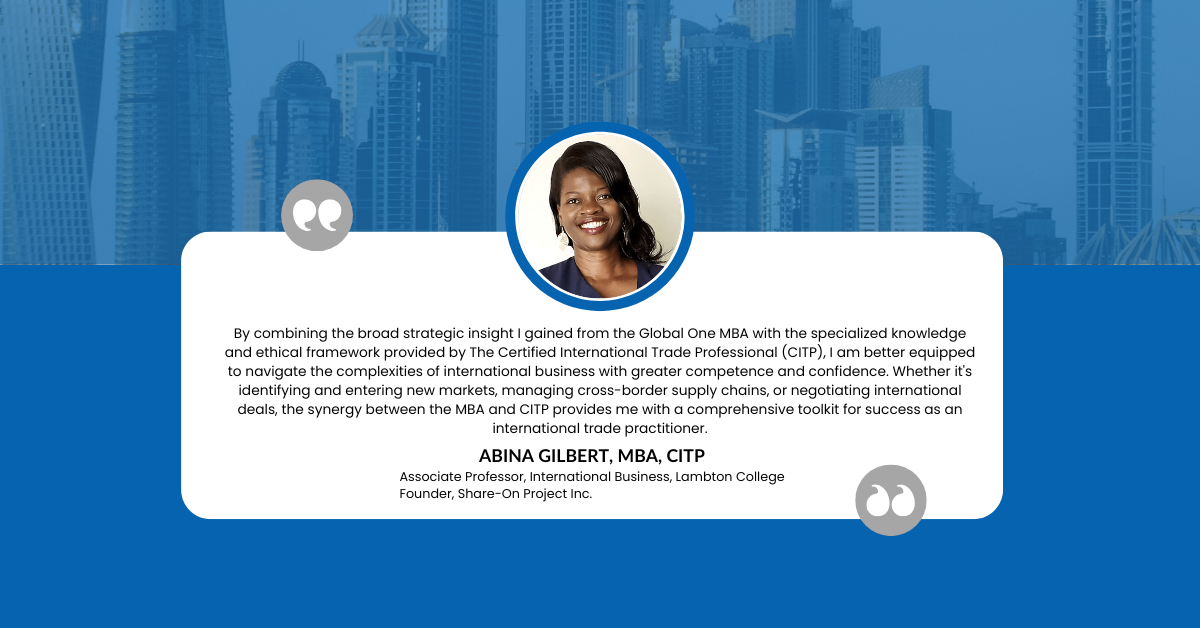
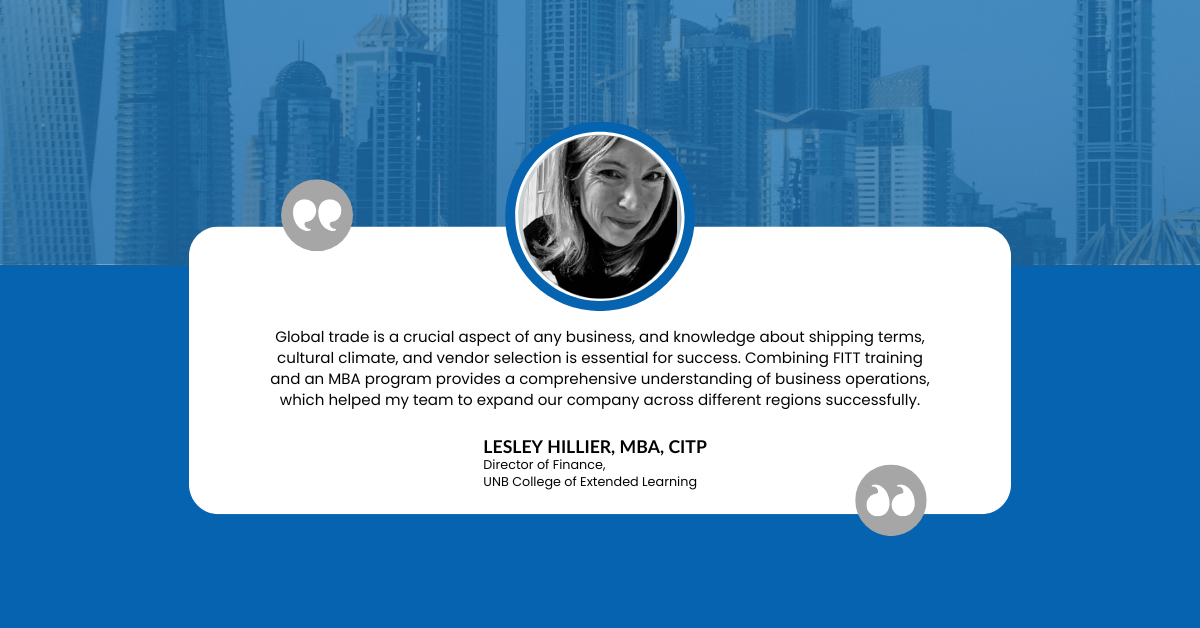
Not sure if the CITP is right for you? Read what other CITPs, many who also have their MBAs, have to say about earning their designation and how it has helped their careers, here.





disqus comments